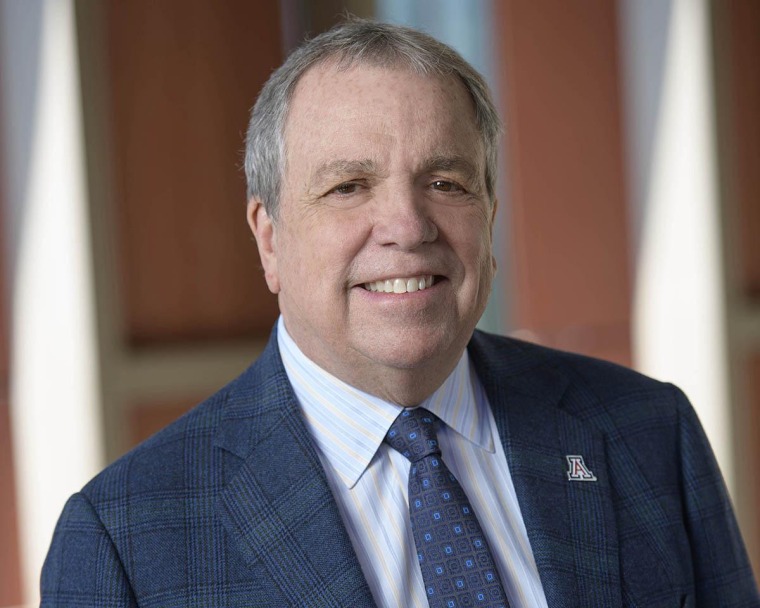
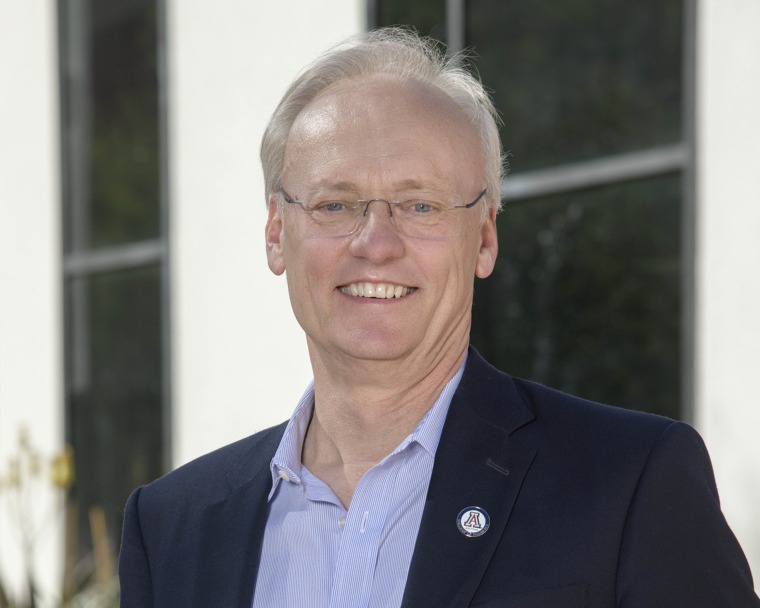
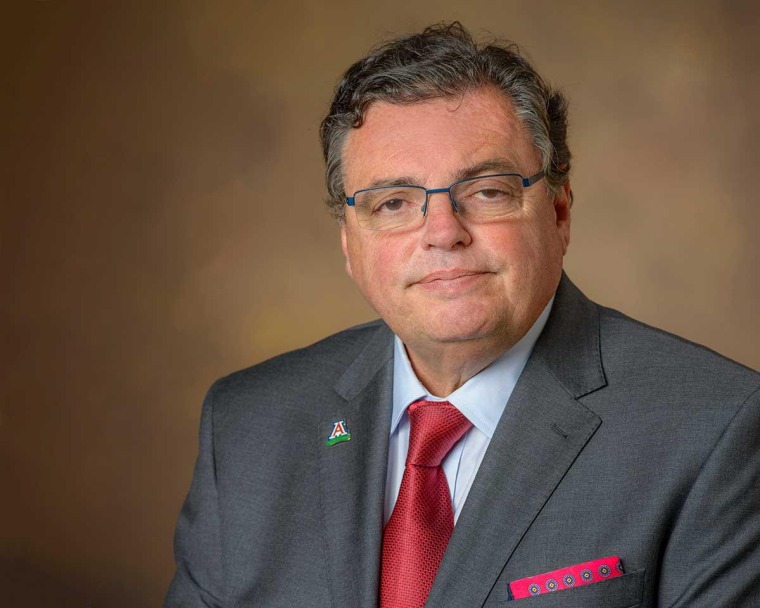
Samuel M. Keim, MD, MS, head of the University of Arizona Department of Emergency Medicine, a part of the UA College of Medicine, met with Mayor Rothschild today to thank the mayor for his proclamation and to discuss emergency medicine programs, services and trainings the department offers to the community.
The Preparedness Training Institute and the Arizona Resuscitation Research Institute, programs of the UA Department of Emergency Medicine, fulfill their missions by offering training to emergency medicine services providers, locally and nationally, that are aimed at reducing morbidity and mortality in emergency care. 
Samuel M. Keim, MD, MS, head of the UA Department of Emergency Medicine will meet with Mayor Rothschild on Wednesday, May 22 at 10 a.m., to thank the mayor for his proclamation. Also on Wednesday, University and South Campuses will participate in a statewide emergency-preparedness exercise.
The Medication Management Center at the University of Arizona College of Pharmacy has been selected to receive a 2013 Pinnacle Award from the American Pharmacists Association (APhA) Foundation.
Four times a year, two University of Arizona neurologists drive 1,200 miles across Arizona's Four Corners area to deliver clinical expertise to an underserved indigenous population that otherwise would have to do without such specialty care or travel several hours for it to Flagstaff, Phoenix or Tucson.
Dr. David Labiner, head of the UA neurology department, has offered quarterly neurology clinics at Indian Health Service and health-care facilities on the Navajo and Hopi reservations for about 15 years and bimonthly ones in Flagstaff for 20 years. Common consultations include treating patients for epilepsy, Parkinson's or Alzheimer's disease, stroke recovery, headaches and neuropathy.
"We get paid a flat fee no matter how many patients we see in a day – so, from a purely business sense, they (IHS and tribal health authorities) are providing specialty service in a much more efficient way. And, since they're obliged to provide transportation for many of their patients, it really saves them tremendously for us to be there," Labiner said.
"Now, many of the hospitals have CTI or MRI scanners, but when I started they didn't. I used to joke that if we saved them one MRI test because this patient didn't need one, the cost of the MRI and transportation paid for my visit there."
First invited by a physician he met at a North Carolina medical conference who was the only one offering neurology services in the tribal areas at the time, Labiner began doing clinics in Flagstaff in the early 1990s. They were held at the practice of the late Dr. Nate Avery, a neurosurgeon and UA College of Medicine alumni who died last year after a fall near Lake Powell.
Avery's partners, Dr. Brad Nicol and Dr. David Sacco, now host the Flagstaff clinics. In about 1995, Dr. Labiner was asked by an IHS physician if he might expand the clinics to Chinle, Ariz., on the Navajo Nation. That led to more requests for clinics in Winslow, Polacca (on the Hopi reservation near First Mesa), Tuba City and Kayenta, Ariz.
Dr. Joe Salay, a family practitioner at the Chinle Comprehensive Health Care Center for 25 years, said, "Having a person come to Chinle and provide those services onsite has benefited a lot of our patients. They've benefited medically, financially and socially. He provides good care. He's very thoughtful."
Patients, many of whom are unemployed or underemployed, often may not have the means or resources to travel far. Sensitivity to that and other issues, such as Native American taboos about epilepsy or places where people have died such as hospitals, is required. Labiner's years of service give him a trust advantage over newer or transient clinic physicians, Salay said, due to cultural familiarity and continuity of care not just with patients but local primary care providers, too.
Some patients he sees are still those same folks he began treating 15-20 years ago at early clinics to the area. The No. 1 thing that's changed in that time, Labiner said, is older, more traditional Native Americans' openness to accept an outsider to see them and their willingness to discuss more advanced treatments, such as surgical intervention for epilepsy or Parkinson's. Local doctors also are more comfortable having their patients on newer generation medicines because they know "we're there for backup – only a phone call away."
Today, Labiner does the Flagstaff clinics every other month and alternates with University of Arizona Medical Center epilepsy specialist Dr. Myrka Torres, "riding circuit" during the weeklong quarterly trips. Per week, they'll see about a hundred patients, who may have traveled a few hours to several themselves to get to the clinic due to poor roads across the wide expanse of rough, sparsely populated terrain.
The doctors, typically, take a resident or fellow along to assist. That's how Torres got involved both as a University of Arizona Medical Center resident and fellow. They'll often have a morning clinic in one place, an afternoon clinic a couple hours away and, then, drive a few more hours to the next day's clinic site. Occasionally, they coordinate with clinics to the area hosted by the UA Native American Cardiology and Medical Service Program that have been ongoing since the 1970s.
Dr. Eric Brody, that program's medical director, said, "The wonderful thing about the work Dr. Labiner does, or work our program does, is that we often see these patients here at UAMC when they're being evaluated or diagnosed with really serious illnesses; and going back to see them when they're closer to home is not only invaluable from a medical care perspective, but it's so cherished by the patients."
One of the most rewarding things as a physician, Brody said, is the recognition and happiness apparent in a patient's eyes when they see a familiar face behind the stethoscope – "the value of that cannot be calculated."
Labiner agreed.
"It's a great experience on many levels, and we're providing a tremendous service to our state at the same time," he said. "It's one of the prettiest places in the state. The downside is we get caught in the snow because we're there in the winter, also. It's really nice in the spring and fall – not as nice in the winter… Still, it's a win-win all around. Patients appreciate it, residents enjoy it and it's a service we as a state institution should help to provide."
An shorter version of this article appeared in the May issue of the Network News, a publication of The University of Arizona Health Network which includes UAMC-University Campus, UAMC-South Campus, dozens of clinics, several health plans, and The University of Arizona Physicians – the practice plan of the faculty physicians of the UA College of Medicine.
Original article - UANews.org >> http://uanews.org/story/bringing-neurology-care-to-arizona-s-four-corners-region
Kathleen C. Insel, PhD, RN, associate professor at the University of Arizona College of Nursing, was appointed by the Patient-Centered Outcomes Research Institute (PCORI) to serve on its newly established stakeholder Advisory Panel on Assessment of Prevention, Diagnosis and Treatment Options.
When amyotrophic lateral sclerosis (ALS, or “Lou Gehrig’s disease”) took the life of Jim Himelic, a friend of the Tucson community and much-respected juvenile court judge, in February 2000, his family, friends and colleagues created the Jim Himelic Foundation (JHF) with the goal to raise $1 million in “seed money” to fund local research of ALS, a progressive, fatal neurodegenerative disease that can strike people from all walks of life and of any age. Although significant advances have occurred in the medical community’s understanding of the processes underlying ALS since baseball legend Lou Gehrig passed away from what has come to be known as “Lou Gehrig’s disease” more than 70 years ago, there still is no effective treatment.
Dr. Zarnescu is modeling ALS in the fruit fly Drosophila, a powerful genetic model that harbors several genes similar to those linked to human neurological and neurodegenerative disorders. Using this model, Dr. Zarnescu’s team recently completed a drug screen for compounds that alleviate ALS-like symptoms, including locomotor dysfunction and reduced survival. Efforts are under way to select promising compounds with therapeutic potential.
Ronald S. Weinstein, MD, founder and director of the Arizona Telemedicine Program, has been inducted into the United States Distance Learning Association Hall of Fame.
Sean P. Elliott, MD, has received the “Leonard Tow Humanism in Medicine Award,” presented by the Arnold P. Gold Foundation.
With this award, Dr. Elliott becomes a member of the Gold Humanism Honor Society (GHHS), an international society with 104 established medical school chapters throughout the United States.
Since it began in 2001, Tucson’s annual Himelic Memorial Dinner and Golf Classic has raised $832,000 to benefit amyotrophic lateral sclerosis (ALS) research at the University of Arizona College of Medicine – Tucson. The funds are “seed money” that allow UA researchers to conduct the preliminary research necessary for obtaining larger government and private grants to further their studies of ALS.Sponsorships (deadline May 10):
Since it began in 2001, Tucson’s annual Himelic Memorial Dinner and Golf Classic has raised $832,000 to benefit ALS research at the UA College of Medicine – Tucson.